Library Facts for Faculty

Welcome back, faculty!  Or, in the case of brand new faculty—welcome to Arkansas Tech!  The Ross Pendergraft Library offers many services to support the research, curriculum, and curiosity needs of faculty, on or off-campus.  Here’s a list of a few of top-requested services and resources from the faculty to help introduce you to the Library.  For an abbreviated summary of our resources, check out our Library Resources for Faculty guide.

Course Reserves

Would you like to set aside a book, a textbook, or a DVD for your students at a Circulation Desk?  Faculty can share their own copy or select a library item to put on course reserve for limited-checkout to their students.  To get started, fill out the form that best describes your material:

Once the items are placed on reserve, they can be searched by course number, professor name, or title using our online catalog, course reserve drop-down.
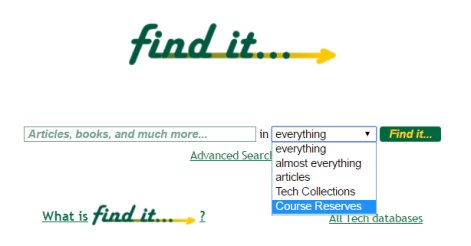
finditcourse

Library Instruction

If there’s a research paper or project on your course syllabus, and you are already bracing yourself for Wikipedia citations, consider inviting one of our librarians over for a quick tutorial on library resources.

In 50 minutes or less, a librarian can help de-mystify searching, finding, and citing for basic scholarly research.  In addition to classroom instruction, we can provide tours, short overviews of library databases, or more focused tutorials on subject-specific projects and papers.  If you are teaching a Research Methods class, this service can be particularly valuable.  Contact us at askalibrarian@atu.edu to schedule a session.

Resource Guides

Don’t have time for dedicated instruction on library materials?  The librarians are hard at work building online research guides devoted to specific subjects, majors, and even specific courses.  Custom guides can be built for use with specific projects, or generic guides tweaked to include added information.  These are great places to start students down the right path to subject-specific databases, journals, citation help, and more.  Browse our current collection for research guides to share in class or send us an email with your own suggestions and requests.

RefWorks

If you are producing scholarly research, this tool is invaluable for managing citations, importing references, and creating bibliographies.  Most commonly described as “something I wish I had known about when working on my PhD”, use Refworks to access and organize your citations from anywhere. Find embedded links within our databases and online catalog to quickly add references to your lists.  Export directly into Microsoft Word your fully-formatted bibliography in whichever citation style you choose.

The Chronicle of Higher Education

Want to read it?  For free?  The library has a subscription.  Follow this link:

http://bit.ly/2bBGzcl 

Click on “View Online” to see the link for full-text for current articles and older content back for two years.  You can also search the title in our library catalog to find the print issues, the electronic archives, and specific articles.

Interlibrary Loan

The library has expanded our collection tremendously in the past few years, but as academic material costs continue to rise, we struggle sometimes to meet all the research needs of faculty.  Enter the twin engines of speed and customer service:  ILLiad and the outstanding department of Interlibrary Loan.

Our Interlibrary Loan services help you obtain full-text articles and books not held in our own collection.  The ILLiad software makes requesting materials from our databases a breeze.  Look for the ILLiad logo every time you see a citation without full-text access:
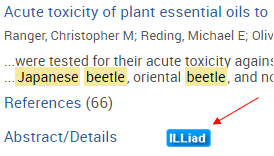
illiad

Use our WorldCat database for requesting books not held in our collection—you’ll find the ILLiad logo there, too.   Login to ILLiad directly with your Tech username and password to track requests, view received articles, and more.

Have a problem or a question?  Get in touch with our Interlibrary Loan specialist (a.k.a. your new best friend) who will go to the ends of the earth to find what you need.  You can also call or stop by the ILL office in RPL 124 during regular office hours.

Citation Measurement

On occasion, we are asked for help finding citation metrics to help faculty measure the number of articles referencing their work.  Here are a few tools to assist in obtaining these numbers:

  • Web of Science: This is the most authoritative source for citation metrics in the sciences and social sciences. You can find Web of Science in our list of A-Z Databases.   Search for your article or yourself as an author to view the number of times your work has been cited.  Arkansas Tech currently subscribes to the Science Citation Index only, however, so analysis in other disciplines (e.g. arts and humanities) will be limited.

webofsci

  • GoogleScholar: This a free service offered by Google, and considered the largest collection of citation metrics.  Google’s web-crawler has captured millions of citations from publisher sites, institutional repositories, and individual author sites.  However, it is prone to over-inflated metrics at times because it includes so-called “ghost citations’ like duplicate foreign language translations and falsely attributed citations.  Be careful using these numbers for true indications of research quantity and quality without verifying the sources of the citations.

googlscholar2

  • Publish or Perish by Harzing: This software tool can perform citation analysis using information from Google Scholar and Microsoft Academic (still in early development stages).  The software not only provides a citation analysis of individual works, but also of the scholarly output and measure of a single author or an entire journal.  It is capable of calculating metrics like H-Index, G-Index, and other citation ranking statistics.

Did we leave something off this list?  Contact your factual, faculty-friendly librarians at askalibrarian@atu.edu.  You can also keep in touch with new library news through our Facebook and Twitter.  Happy New Year!

Olympic Throwback

Tucked away in the rare book collection of the Ross Pendergraft Library is a curious piece of Olympic history.  Inside the library’s Special Collections is a volume documenting the history of the 1932 Olympic Games in Los Angeles,  Die Olympischen Spiele in Los Angeles 1932

WP_20160811_14_53_24_Pro

Published in Germany in 1932, shortly after the games have ended, the book contains 200 black and white and hand-colored photographs.  What makes this particular book so special is the fact that it is a completed cigarette card album.

WP_20160811_14_55_07_Pro3

Cigarette cards originated in the 1870’s to stiffen cigarette packs.   Advertisers quickly realized the potential, and they started printing pictures and other information on the cards for people to collect.[1]  The most famous example of this were baseball cards, which first became popular in the 1880’s and continue to be collectors’ items today.[2]  The tobacco companies would sell special albums for particular sets into which you could paste your collection of cards.

WP_20160811_14_55_35_Pro2

Not only is this book unusual in form, it is also worth noting that the text was produced in Germany—by a German cigarette company, Reemstma—during the build-up to World War II and the rise of Nazism.   This is a primary source of their impression of these multi-cultural games held in the United States.  Germany was to host the next Olympic games in 1936.

WP_20160811_14_57_19_Pro2

In this volume, the cards have been securely pasted onto the yellowing pages, and feature beautiful glimpses of athletes, dignitaries, events, and venues in stunning detail.

WP_20160811_14_55_49_Pro2

Read more about the 1932 Olympics, Cigarette Cards, the astonishing story of the 1932 women’s 100 meter gold medalist, Stanislawa Walasiewicz, in our history database, Historical Abstracts with Full Text.

WP_20160811_14_58_34_Pro2

Special Collections contain the library’s rare books, Arkansas materials, Arkansas Tech publications, and the master’s theses produced at ATU.  You can discover this collection in our online catalog by limiting to location “Special Collections”.

WP_20160811_15_00_21_Pro2

These materials do not check-out, but you may read, touch, and smell these rare items within the library by making an appointment.  To do this, send an email to the keepers of the Olympic torch at askalibrarian@atu.edu or pole-vault over to the reference desk where our friendly staff still hold the world record for 100 meter customer service while wearing a cardigan.

WP_20160811_15_03_50_Pro2


[1]Archer, C. (2004, Apr 22). PRINT’S PAST: Cigarette cards. Printweek, , 62. Retrieved from https://libcatalog.atu.edu:443/login?url=http://search.proquest.com/docview/230399621?accountid=8364
[2] “Library of Congress Web Site Offers More than 2,100 Early Baseball Cards on-Line.” U.S.Newswire, Sep 30, 1998. https://libcatalog.atu.edu:443/login?url=http://search.proquest.com/docview/451185971?accountid=8364.

Pardon Our Progress

It’s now high summer.  The campus is mostly quiet, and the geese are taking full advantage of the lull in student population.

geesewaybetter

But inside the Ross Pendergraft Library, things are shifting and shuffling around.    Big changes are in store for the upcoming fall semester, and the staff here are hard at work managing the multiple projects going on this summer.

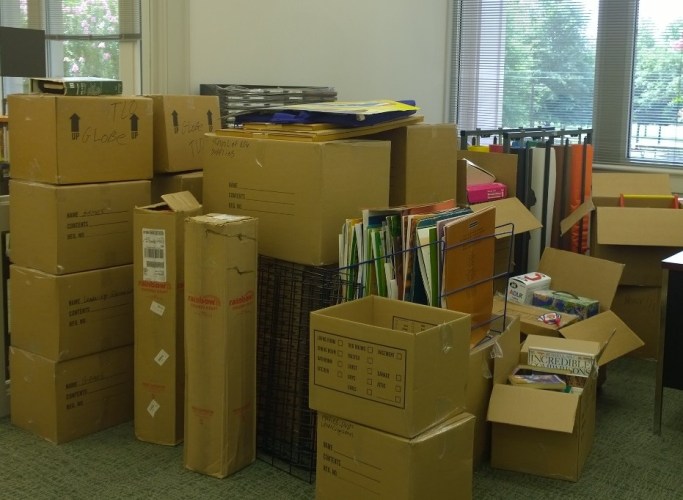
One of those projects involves the migration of the Curriculum Materials Library from Crabaugh Hall to the Ross Pendergraft Library.  Over 6,000 volumes of children’s books, teaching materials, and young adult fiction will be integrated into our existing book collection.

The new addition will also include a die-cutter tool for making bulletin boards, a laminating machine, butcher paper, kits, oversize story-books, and more.  A Young Adult Fiction section will be created, as well as a separate collection for teacher preparatory materials, called the Curriculum Library Collection.

In the fall, this space will be ideal for the future teachers of Arkansas to explore a diverse and modern children’s book collection along with a wealth of resources for classroom preparation.

Right now, however, we have some work to do.

clstuffWhen the migration is complete, a full celebration of the new Curriculum Library will be held later in the semester.  But for now, we want to highlight just some of the people doing the hard work to make all of this possible.

WP_20160729_11_27_07_Pro

Circulation workers, Amanda and Mackenzie, trying to avoid paper-cuts.

It takes skilled, dedicated, and resourceful people to merge two library collections together in less than a few weeks.  Boxes have to be moved, sorted, unpacked.  Shelves have to be moved and put together.   Heavy boxes, heaved.

wp_20160729_14_59_11_pro

Cheyenne at the Circulation Desk, undaunted by the unlabeled

Incorporating the new books involves cataloging, barcoding, stamping, labeling, re-labeling, shelving, and shifting.  Ultimately, it involves teamwork, precision, patience, and sometimes band-aids.

Beverly Cooper, probably the best ever.

Beverly Cooper—Reference Desk rock star, keeper of the good band-aids—getting another batch ready for the shelves.

It can be tedious, monotonous, and outright boring work.  But the end result is all worth it:

WP_20160729_11_33_15_Pro

If you are looking for children’s books this summer, they are located in the areas directly behind and adjacent to the Periodicals Collection.  As the new books become available, you can find them in our online catalog by refining results on the location, “Youth and Children’s Book Collection.”

Search results for Caldecott in the library collection, limited by Location: Youth and Children's Book Collection.

Kids are always welcome in the library, especially the kid inside us all.  For more information about this new collection, including advice on great children’s books, contact your young-at-heart librarians at askalibrarian@atu.edu.   We’re here all summer to assist you with your research and reading requests, and we’re sure you’ll find a rainbow of materials to inspire and interest you.  But you don’t have to take *my* word for it…


Keep Calm and Pokémon

There’s no need to stand in the heat to catch your Bulbasaurs.  Come to the Ross Pendergraft Library, now a PokeStop in the popular creature-grabbing, location-based app.

screenshot of Pokestop

In case you haven’t downloaded the app yet (or are vigorously rolling your eyes right now), there are PokeStops all over campus, including gyms at Bastech, Doc Bryan, and Tech Baseball Field.  You can view the full map, as of 7/18/16, here:

campus map of pokestops
Stop by the library, catch ‘em all, and while you you’re at it, catch some other things like DVDs, books, and research articles.  The library is open all summer long to satisfy your academic and casual knowledge cravings.

Think you can design a game better than Pokémon Go?  Learn how with our new books to support the Bachelor of Arts in Game and Interactive Media Design.

briefhistoryA brief history of video games


gameart

Game art : art from 40 video games and interviews with their creators


stateofplayThe state of play : creators and critics on video game culture


introIntroduction to game design, prototyping, and development : from concept to playable game-with Unity® and C#


embedwithEmbed with games : a year on the couch with game developers / Cara Ellison.


levelupLevel Up! The Guide to Great Video Game Design


Want to stay up-to-date on all the Pokémons going on?  Follow us on Twitter.  Friend us on Facebook.  Or just be our friends by emailing your Pokédex catalogers at askalibrarian@atu.edu.  Happy hunting!

‘Freedom Riders’ Screening

Please join us Wednesday, April 20, 2016 at Ross Pendergraft Library and Technology Center as we present the documentary film Freedom Riders, an event that is free and open to the public. This film is part of the series Created Equal: America’s Civil Rights Struggle, in cooperation with the National Endowment for the Humanities and the Gilder Lehrman Institute of American History. The event will take place in room 300B.

In addition to the screening, Arkansas Tech alum Barbara Lackey, a 1960 graduate of Horace Mann High School in Little Rock, will share her experiences on life in the natural state during the civil rights movement and on her experience as a student at ATU.

For more information, please contact us at askalibrarian@atu.edu or call us at 479-964-0569. You may also contact Luke Heffley at 479- 964-0546.

Film Festival Wrap-Up

The inaugural international film festival, held with the cooperative efforts of the Ross Pendergraft Library and the Department of English and World Languages, has drawn to a close. The eight films presented were chosen based on the four languages taught at Arkansas Tech University: Spanish, French, German, and Japanese. Here is a list of films in case you missed them. If these films have peaked your interest in seeing more movies in these languages—perhaps to sharpen your language-speaking skills, to watch more of a director’s movies, or to widen your cinematic viewing know-how—look no further than the RPL DVD selections. Located on the first floor of the library, the DVD collection has expanded in its popular viewing and international selections, and is available to check out to students, faculty, staff, and alumni (information on loan privileges for each patron is available here). Here are a few of my picks, in each language, of movies available in the library:

German

Germany gets a bad rap for being unfunny, but you may find yourself chuckling at a few of our selections, or caught up in the drama and intrigue of others. Many of the choices here relate to activism and anarchy brought about by Germany’s tumultuous times following World War II and the Cold War.

What to Do In Case of Fire? (Was tun, wenn’s brennt?): (2001) An old bomb in a building has just exploded, and six former anarchists have to scramble together to hide the evidence. Hilarity ensues as they get through this less-than-ideal reunion.

Good Bye, Lenin!: (2003) A young man’s mother goes in a coma during the collapse of the Berlin Wall. In an effort to keep her from suffering a fatal shock once she awakens, he goes to great lengths to make it seem as though nothing has changed. It’s a heartwarming mother-son flick, and one of my favorite films we viewed in a German Film seminar I took long ago.

Downfall (Der Untergang): (2004) A gripping drama capturing the final days of the Nazi regime, and one theory to Adolf Hitler’s demise. One particular scene was made infamous on YouTube as a gamer rant. Masterfully filmed, it is an uncommon perspective on World War II.

The Edukators: (2004) A combination of the anarchist film and German Heimatfilm (or nature film set in or near the Alps), The Edukators is like a German-language version of The Bling Ring, except the young people who star in the film are poor students who protest the rich. A young girl and her friends decide to kidnap a wealthy businessman after strapping her with a mountain of debt following a car wreck.


Japanese

Remember watching old Don Bluth films like The Land Before Time, or any of his other whimsical but deceptively heartbreaking animated films, and having a good cry at the overbearing realness of mortality, brought to you with cutesy animal characters and songs? Luckily for you, esteemed Japanese filmmaker Hayao Miazaki and others in the Studio Ghibli universe know full well that the impact of powerful, emotional storytelling doesn’t have to exclude animated films. RPL has an extensive collection of Miazaki’s films, a boon for patrons as these movies are often costly or difficult to find. If animated feels are not your thing, we also have quite a collection of films by Akira Kurosawa, whose feature Yojimbo played at one of the movie nights. Kurosawa’s movies have been a major influence on several American films; for example, the western The Magnificent Seven was inspired by Seven Samurai:

Rashômon: (1950) Following the murder of a samurai, the story of his death is told from the perspective of a bandit, the samurai’s widow, and (through a medium) the victim himself. The film causes viewers to question everyone, as unreliable narrators are everywhere.

Ran(1985) Inspired by samurai legends and and resonant with Shakespeare’s King Lear, a Japanese warlord decides to retire from his position and divide his kingdom among his three sons. If you are familiar with the Shakespeare version, you know that this does not end well. The film is widely held to be a classic and one to see before you die. If you are a fan of long shots and epic battle scenes, look no further.

Grave of the Fireflies (Hotaru no haka): (1988) A young boy tries to survive in Japan with his sister in World War II. After the death of their mother, and unsure if their father will ever return from his duties as a soldier, they must endure starvation and other wartime horrors together, finding sole comfort in watching fireflies at night.

The Tale of Princess Kaguya (Kaguyahime no monogatari): (2013) Based on a Japanese folk tale, the film begins with a bamboo cutter who finds a tiny girl sleeping inside the plant. The beautiful and rebellious young girl, at first the size of a finger, will remind viewers of Thumbelina and other Disney princesses. The film journal Sight and Sound wrote a review of the film last year.


Spanish

Many years ago I was introduced to the works of Spanish director Pedro Almodóvar while channel surfing. I immediately fell in love with the scenery of the country and the complex relationships in which he peopled these stories. RPL has an extensive collection of these films:

Women on the Verge of a Nervous Breakdown (Mujeres al borde de un ataque de “nervios”): (1988) Many of Almodóvar’s movies feature characters of various backgrounds whose love lives cause their paths to cross. In this case, a woman’s lover turns out to be the lover’s lover to another woman.

All About My Mother (Todo sobre mi madre): (1996) Following the death of her son, a woman travels to Barcelona to tell the father, who never knew about him.

Talk to Her (Hable con Ella): (2002) Two men are in love—one with a famous bullfighter and the other with a dancer—both of which are in a coma. The two men form a friendship, but their closeness is tested when one of them commits a terrible crime.

Bad Education (Mala educatión): (2004) The film centers on the lives of two boys who meet in a Catholic school, and their complicated emotional and sexual relationship in the span of 30 years.

Volver: (2006) Spanish for “to return,” a mother who had died years ago comes back to the land of the living to resolve unfinished business with her surviving family. The film stars Penelope Cruz, who appears in another Almodóvar film, Broken Embraces. 


French

French movies are more than just romantic, scenic frolics around the Eiffel Tower; in fact, French cinema is well known for its contribution to the horror genre. Here is a list of a few of my favorite titles:

Diabolique: (1955) From the Internet Movie Database (IMDB): “The wife of a cruel headmaster and his mistress conspire to kill him, but after the murder is committed, his body disappears, and strange events begin to plague the two women.” It is considered a classic horror masterpiece.

Delicatessen: (1991) A French horror film set in the future where a shopkeeper serves up people as meat. Not for the faint of heart and queasy of stomach.

Man Bites Dog (C’est arrivé prèz de chez vous): (1992) This intersting mockumentary begins with an interview with a local serial killer, who explains, “Usually, I start the month with a postman.” The title is translated to English as “It Happened in Your Neighborhood.” Set in black and white, it is a meta-film about three directors (starring the directors!) filming a serial killer, who wind up getting their hands dirty in the process.

High Tension (Haute Tension): (2003) An excellent selection if you like your horror with a little psychoanalysis and feminist resonance. Although not available at RPL, director Alexandre Aja helped write this fairly recent horror film that plays with point of view, which you should definitely add to your Netflix queue if you enjoy the classic slasher film style of 80’s and 90’s horror.


If this list of suggestions has further whet your appetite for more international titles, use our Find It… tool to search for more! The library’s film collection continues to grow, so keep an eye out for new titles.

There’s a Map for That

Delve into Arkansas History with our latest database collection, “Digital Sanborn Maps, 1867-1970: Arkansas”.  This rich collection of early maps of cities and towns reveal the original footprints of buildings throughout Arkansas.  Sanborn maps were large-scale plans of a city or town, drawn to a scale of 50 feet to an inch.  These were created from 1867 to 2007 to assist fire insurance companies in assessing the risk of fire to various structures and buildings.  Today, they are used for a wide-variety of purposes, particularly for historic research, urban planning, or restoration of older homes and buildings.

A Sanborn map can show you street names, block numbers, sidewalks, railroad tracks, the location of water mains, churches, businesses, windows, doors, and even porches.  These maps–now digitized and available in an easy-to-search, online database—can carry you back in time to show you how a particular place looked over 100 years ago.

The Library owns the Arkansas collection  of digital maps, which include maps on just about every town in the state.  Smaller towns may contain only a few maps, but larger cities, such as Russellville, will contain maps from multiple years, spanning from the mid-1800’s to the mid-1900’s.

sanborn1

Once you have selected a city and a map, download the map for easier navigation and zooming.  There is even an option to print selected areas.

Sanborn map 1886, Russellville

July 1886, Sheet 1. One block on Main Street. The train depot is further left, with what is now Denver Ave. bordering on the bottom. The Central Hotel is now Sportscene.

Googlemaps image of Russellville block, modern day

Same block, circa 2016 Google Maps

Travel back in time today by exploring the Digital Sanborn maps.  For other questions about this resource, the library, or other databases available to you as an Arkansas Tech student, consult your Timelord librarians at askalibrarian@atu.edu.

Library Survey

Do you think the library needs more computers? More study rooms? Less big tables, or more? Do you use some technologies and services more than others? Do you need more help getting the most out of your library experience? This is the time to let your voice be heard!

The school year is drawing to a close, and once again the librarian staff of RPL implores patrons to open our minds by taking the annual survey. This is an opportunity for students, faculty, staff, and alumni and community patrons to give us feedback regarding services and materials, as well as provide comments on levels of satisfaction. Feedback from this survey helps us determine what needs are being met, what sources are being used the most or least, and how best we can serve patrons throughout the year.

The survey is available on our website. Estimated time of completion is 6 minutes. The majority of questions issued relate to the relevance of available sources, both physical and electronic; the frequency with which these items are used (such as multimedia, microforms, periodicals, ebooks, etc.); and the satisfaction of service from circulation, reference, and interlibrary loan (ILL). Other services, such as individual instruction and special events, will also be a topic for feedback.

The deadline for taking the survey is Monday, April 11 at 11:59 pm. Please complete it as soon as possible. We really want to know what you think about us and how we can make this the best library for you!

just do it

History of Headstones

Join us  this Tuesday night, April 5th,  at 7:00 P.M. in room 300B of the Ross Pendergraft Library & Technology Center for a special presentation on the history of cemetery headstones.  Guest speaker, Holly Hope from the Department of Arkansas Heritage, will share her extensive knowledge of cemeteries and headstone symbolism found on graves from around the state.  Learn all about graveyard symbols like lambs, broken branches, clasping hands, and weeping angels this Tuesday night at the library.  This event, presented by the Ross Pendergraft Library and The Department of Arkansas Heritage, is free and open to the public.

Mt. Holly Cemetery, from Arkansas Historic Preservation Program website

Special Announcement

LIBRARY TO DISCONTINUE BOOKS, PHYSICAL ITEMS

The Ross Pendergraft Library of Arkansas Tech University recently announced its plans to phase out all print materials from its facility. Beginning April 1, 2016, all books, periodicals, newspapers, law books, maps, dictionaries, microforms, and other physical items will be systematically de-shelved and destroyed. Library Director Brent Etzel stated to the bored local and national press, “Everything you could ever want is online or digitized now, and patrons rarely use these physical copies anyway, so we might as well get rid of them. Students and courtesy patrons only come here to use the computers, anyway.” Following his announcement, held outside the library steps, he glanced wearily at the face of Ross Pendergraft and muttered solemnly, “All in all, we’re just another brick in the wall,” before trudging indoors, avoiding further comment.

Chareen Austin, Circulation Manager of RPL, voiced her approval of the decision. “Once all the books, DVD’s and reference items are out of the building, student workers  and library staff can devote more time to helping patrons with the computers, since they won’t have to check in, check out, or re-shelve items anymore. With all this free time, I think we’re gonna start lending out student workers for ditch-digging duty. I hear the university approved plans to build a reservoir for Lake Tech.”

trashed library

Progress has been swift following the library’s announcement

The removal of said items, admits Circulation staff, will be no easy feat. Among these items are over 160,000 bound volumes of books, over 4,000 CD’s, 6,000+ DVD’s, 110,000 government documents, and the current and backlogged issues of over 300 scholarly journals. Special collections, popular reading, and children’s reading will also be “done away with,” stated Etzel. The library director did not provide details on what was to become of these items, but some reporters caught subtle references to a Ray Bradbury novel; anonymous insider information recently leaked online revealed a top-secret library staff “retreat” to be held following initial removal of items. Although the itinerary was composed of code writing consisting mostly of call numbers in both Dewey Decimal and Library of Congress, so far Internet code breakers have managed to piece together the call numbers on books in the recreation section that includes recipes to campfire s’mores. RPL library staff could not be reached for comment.

When asked about the dozens of artwork housed in the library, Etzel paused, then answered, “Yeah, we could probably trash those, too.”

Feedback from students on campus was mixed; some responses included “Meh,” and “The library has books?”

Click here to see the proposed schedule of physical items leaving the library.


………………

Gotcha! Happy April Fool’s, everyone!